When Amazon Web Services launched its S3 object storage in 2006, 1 GB of S3 storage cost $.15 per month. For Comparison, in that same year a 500 GB Seagate Barracuda drive cost $300. S3 seemed a radical idea at the time and its simple value proposition and frictionless consumption ushered in the era of cloud computing.
Thirteen years later, there are dozens of cloud storage providers across the world, and that S3 price of $.15/GB has fallen to $.023/GB, a factor of 7X. And Amazon has launched additional tiers of object storage including Glacier Deep Archive targeted at replacing tape backups and archives. Glacier Deep Archive is priced at an astounding $0.00099 per GB per month. At this price point you can store 1 Petabyte of storage for only $1,000/month!
For this blog post I wanted to examine the cost of SSD vs spinning disk in the context of active object storage. Not the cheapest/deepest tier, but object storage that would be hot and accessible within milliseconds instead of the hours of AWS Glacier. I am looking for the type of storage for file-based data such as images, videos, log files and user files like spreadsheets, presentations, etc.
In this case I chose two products. A 16TB HDD from Seagate and a 4TB SSD from Samsung.
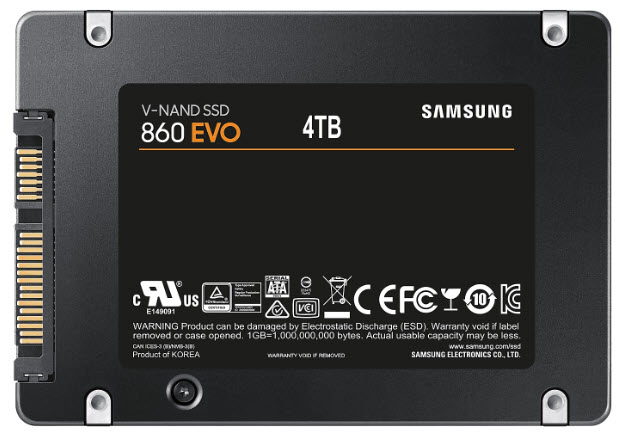
Below, the $580 4TB Samsung 860EVO available from Amazon found here.
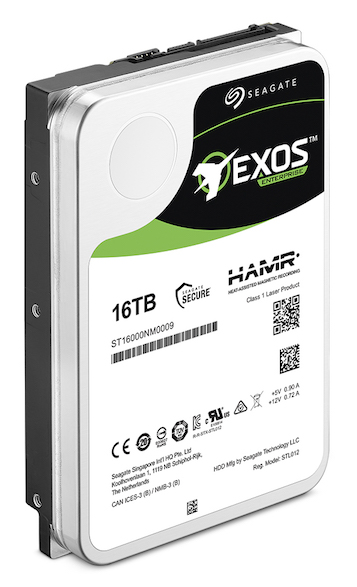
Below, the $545 16TB Seagate Exos Enterprise Drive found here.
While it can be argued that the Samsung 860EVO is not an “enterprise” drive , it represents a class of storage applicable for commodity file purposes with performance meeting or exceeding what’s needed for traditional object storage.
Now that we have identified our drives, we need to pick an expected lifetime. Both the Seagate and Samsung disks are backed with a 60 month limited warranty. However due to the overwrite cycles (Samsung claims they are tested to 2,400 TB written per drive) I decided to normalize on a 36 month economic lifetime for both devices.
For protection, object storage systems like Ceph typically use 3X replicas for data protection rather than more expensive RAID systems. Newer data protection schemes like erasure coding can lower the overhead factor further from 3X to 1.6X providing more usable capacity per GB installed.
Finally, I have eliminated space, power and cooling from the equation. This will typically fall in SSD’s favor by as much as 2X advantage. However there are so many assumptions and factors involved including the density improvements in HDDs I am eliminating it as it will be a small fraction of the acquisition cost of the GB in any case. I am also not calculating the cost of a DAS host server as these will be needed in both cases.
Now that the assumptions are out of the way let’s look t the numbers:
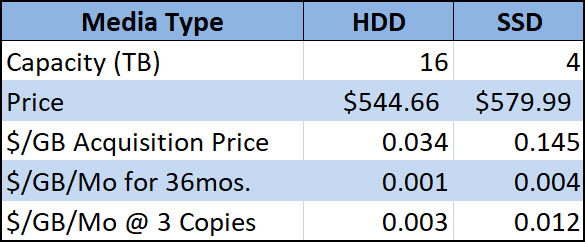
What is surprising is that the cost for 3 replicas on SSD is now 1.2 Cents/GB per month while the cost of storage on disk at AWS S3 is 2.3 cents per GB. In fact if you do the math, S3 pricing since 2006 has come down only by a factor of 7X, while the overall price of hard disk drive per GB has come down 17X. This appears to be opening the door for a new tier of object storage that is SSD backed and offers near-block performance. Technologies such as Vizion.ai’s VBOS technology are designed to take advantage of these new technologies.
Finally let’s graph the current state-of-the-state for highly redundant object storage. HDD clocks in at $.003/GB/Mo while SSD is at $.012, a factor of 4 difference which makes sense–given that HDD currently enjoys a 4:1 price performance advantage.
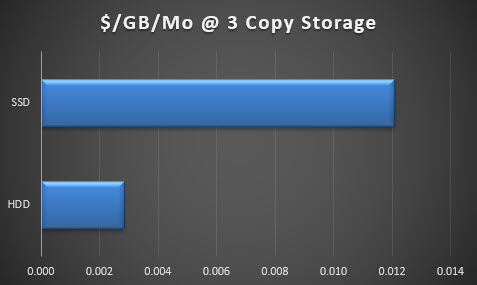
In conclusion, HDD still wins on pure cost, while SSD is narrowing the gap and once SPC is factored in this may narrow the gap further. It is an exciting time to watch storage capacities grow and new applications emerge that take advantage of it.