The Factory Moves to Orbit: Starfall, Microgravity Medicine, and the Rise of the In-Space Manufacturing Startup
For most of the space age, “manufacturing in space” was a line item in a NASA study deck — a promising footnote perpetually one decade away. In the span of a few weeks this summer, it stopped being a footnote. SpaceX flew and recovered a purpose-built return capsule. A San Diego biotech printed human liver and kidney tissue in orbit for the first time. And the drug that has quietly been the industry’s proof point for a decade — Merck’s Keytruda — kept validating the whole thesis. The pieces of an actual industry are snapping together, and the pace has picked up sharply.
Here’s what changed, why microgravity is worth the trouble, and where this goes next.
Starfall and the return-logistics problem
The dirty secret of orbital manufacturing has never been making things in space. It’s been getting them back. You can run the world’s most elegant crystallization or bioprinting run at 400 kilometers up, but if you can’t return the product to Earth cheaply and at volume, you don’t have a business — you have a science experiment.
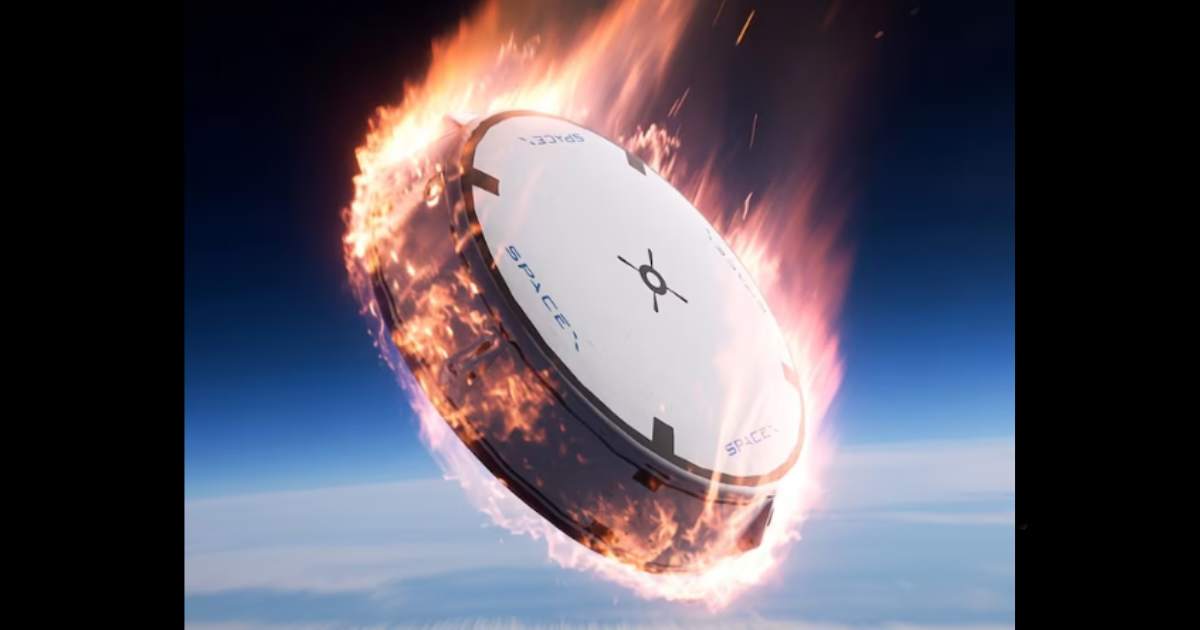
That’s the bottleneck SpaceX just took a swing at. On June 23, 2026, a Falcon 9 lofted the first Starfall demonstration mission from Cape Canaveral, and by June 25 the capsule had splashed down in the Pacific and been recovered to the Port of Long Beach for inspection. SpaceX developed the vehicle almost entirely in secret — it cut the launch webcast about ten minutes after liftoff, the kind of thing usually reserved for national-security payloads.
Starfall doesn’t look like a spacecraft. It’s a flat, disk-shaped puck — roughly 3.1 meters across and 0.75 meters tall — with no propulsion of its own. It rides the Falcon 9 second stage down to a reentry trajectory, jettisons a carbon-fiber heat shield, and parachutes to a Pacific splashdown about 1,300 km off the West Coast. The design is deliberately simple and mass-producible, and Starship could eventually carry several units per launch.
The number that matters: Starfall is speced to return up to 1,000 kilograms of payload per mission. Today’s market leader, Varda Space Industries, returns roughly 30 kg per flight with its W-series capsules. That’s not an incremental improvement — it’s roughly a 30x jump, and it’s the threshold at which orbital manufacturing starts to pencil out for real production runs rather than boutique research.
There’s a strategic wrinkle worth naming, because it’s the part that should make every other startup in this space pay attention. SpaceX already controls launch. Every orbital-manufacturing company currently flies its return capsules as SpaceX rideshare — SpaceX is effectively the landlord for its own competitors. Starfall converts that landlord position into vertical ownership of the entire return-logistics layer. It’s the same pattern we’ve watched with Starlink and elsewhere: identify the infrastructure everyone else depends on, then own it outright. If you’re building an orbital-factory startup, your launch provider just became your competitor. That’s a dynamic worth planning around now, not later.
Why bother leaving Earth at all?
Microgravity isn’t a gimmick. It removes two things that quietly sabotage precision manufacturing on the ground: sedimentation (heavy stuff sinks) and convection (temperature differences stir the pot). Take those away and certain physical and biological processes behave in ways gravity simply won’t allow. Crystals grow more uniformly. Cells hold their intended positions instead of collapsing into a heap. Fluids mix — or don’t mix — on your terms.
That’s the whole pitch, and it’s not theoretical anymore.
The Keytruda proof point
If you want to know why pharma keeps writing checks for this, look at pembrolizumab — Merck’s blockbuster cancer immunotherapy, better known as Keytruda.
Years ago, Merck’s research labs ran crystallization experiments with pembrolizumab aboard the ISS via the station’s National Lab. Monoclonal antibodies are notoriously hard to crystallize on Earth — they’re big, floppy molecules. In microgravity, with sedimentation and convection out of the picture, Merck’s team produced crystalline suspensions with a uniform, monomodal particle size (~39 μm) at high yield. The matched ground controls came out lumpy and bimodal — a scatter of 13 μm and 102 μm particles. The space-grown suspensions were also less viscous and settled more evenly.
The payoff wasn’t a drug made in space. It was knowledge made in space. Those orbital runs revealed the variables — sedimentation rate, temperature gradients — that Merck then reverse-engineered into an Earth-based process. That work fed directly into an FDA-approved subcutaneous version of Keytruda that patients can receive in minutes instead of sitting through a lengthy IV infusion. Orbit as R&D lab, Earth as factory. For a lot of high-value molecules, that may be the winning model for years — and it’s already delivering to patients.
Auxilium and the bioprinting frontier
The newest and, frankly, most striking data point landed just this month. On July 9, San Diego’s Auxilium Biotechnologies announced that its AMP-1 orbital bioprinter had manufactured kidney and liver tissue aboard the ISS — the first time either has been printed in space. The same mission (AXLM-3, flown on SpaceX CRS-34, splashed down off California on June 17) also produced cartilage tissue and 28 nerve-repair implants, using cells supplied by researchers at Wake Forest University.
CEO Jacob Koffler framed the real breakthrough not as any single tissue but as versatility: one machine, many tissue types. AMP-1 runs on swappable cartridges of bioink — want a different tissue, load a different cartridge, and the cartridges keep for at least six months on orbit. Koffler’s point is that a single flexible platform is what turns a demo into an industry that can scale and pivot to demand.
Two now-familiar reasons this works better off-planet, in his words: in microgravity, cells settle into their correct three-dimensional structure instead of collapsing, and biology simply runs faster — printed stem cells mature and differentiate into usable tissue more quickly. Koffler has a nice way of describing the Earth-side problem the orbit solves: without gravity fighting you, your cells stop behaving like blueberries sinking to the bottom of the muffin batter.
To be clear-eyed: these printed structures aren’t functioning organs, and medical products manufactured in space are still years from clinical use — the regulatory pathway is only now taking shape, with the FDA holding its first workshops on space biomanufacturing. The near-term target is smaller tissue patches to repair damaged organs, not whole replacements. But the direction is unmistakable, and Auxilium is already signing on with the commercial stations — Vast and Starlab — being built to succeed the ISS.
There’s a second use case that ought to interest anyone thinking about deep space: on-demand medicine for astronauts. Koffler envisions sending a library of cartridges on a lunar or Mars mission, so a crew could print the specific tissue or drug an injured astronaut needs, on the spot. When you’re eight months from the nearest pharmacy, a printer that responds to medical emergencies isn’t a luxury — it’s mission-critical infrastructure.
The shape of the industry taking form
Step back and a stack becomes visible. Varda proved the return capsule and, in May, signed the sector’s first big pharma production contract with United Therapeutics. SpaceX just blew open the return-capacity ceiling with Starfall. Merck showed the R&D flywheel actually pays off in approved products. Auxilium demonstrated that the hardest category — living tissue — is on the board. And a wave of commercial stations is being built specifically to host this work once the ISS retires.
For those of us in Texas watching the space economy mature, this is the part worth internalizing: orbital manufacturing isn’t going to be a handful of PhDs babysitting an experiment rack. A real return-logistics-plus-biomanufacturing industry needs capsule technicians, GMP-trained process operators, avionics and recovery crews, and cleanroom bioprocessing staff — the exact kind of credentialed, hands-on workforce that doesn’t materialize on its own. The physics has been proven. The vehicles are flying. The question shifting into focus now is who’s going to build, operate, and staff the factory in the sky.
The decade of footnotes is over. The buildout has started.
Sources: SpaceX / FAA filings and reporting via Space.com, Ars Technica, and Teslarati; Merck & ISS National Lab pembrolizumab research (npj Microgravity); Auxilium Biotechnologies press materials and reporting via Payload, 3D Printing Industry, and AP. Starfall image credit Scott Manley Youtube